
Overview
One operating view for shelves, coolers, shoppers, and equipment.
Lawson and Clobotics completed a flagship smart store pilot in China in three to four weeks. The project connected retail execution, cooler imagery, merchandising rules, and store operations in one shared view.
- Customer
- Lawson
- Market
- China
- Pilot
- Flagship smart store
- Scope
- Coolers, shelves, shopper flow, and store digital twin
Challenge
Store execution remained difficult to measure.
Lawson’s 70/20/10 merchandising rule assigns 70% of the mix to core must-stock products, 20% to locally selected assortment, and 10% to trial or differentiated products. Store teams lacked a continuous way to verify that mix at the shelf.
Manual retail audits covered less than 10% of stores
Supervisor visits and employee self-checks were costly, delayed, and subjective.
POS data could not explain shelf productivity
Sales data did not show whether each SKU’s facings matched demand or out-of-stock risk.
Shopper flow was disconnected from conversion
Teams could not connect cooler dwell time and store routes with product exposure.
Departments worked from separate reports
Merchandising, operations, and equipment teams lacked one view of compliance and cooler health.
Solution
Connect shelf intelligence and cooler operations.
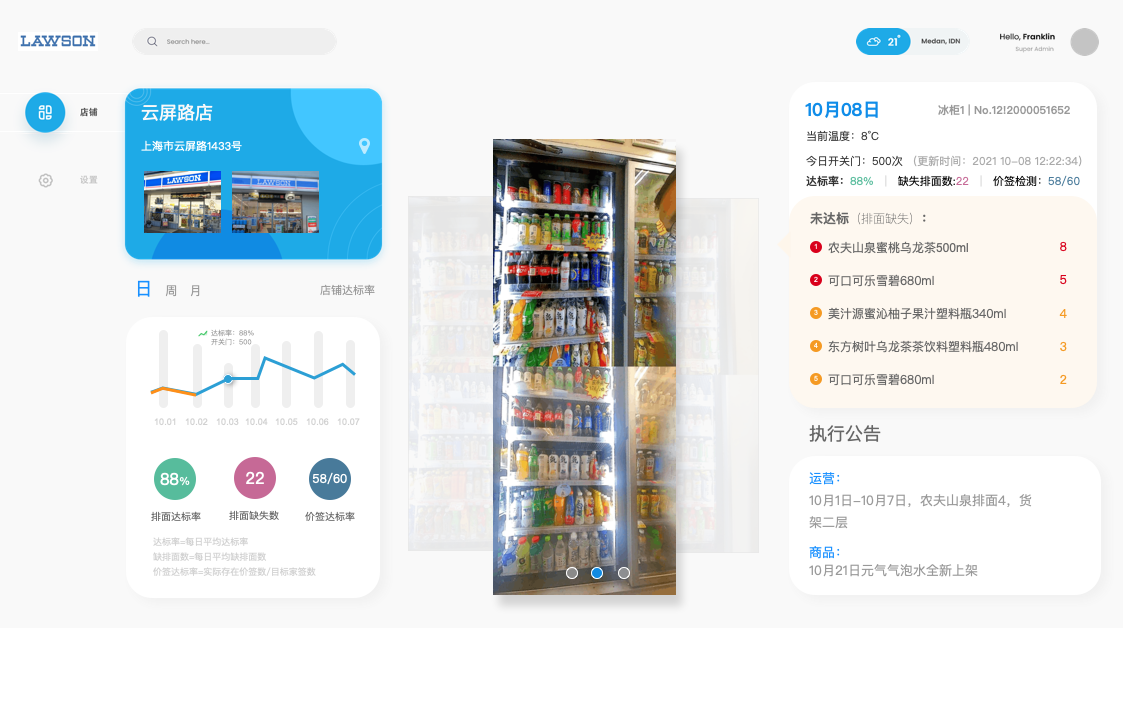
Clobotics combined connected cooler monitoring, shelf-level AI, merchandising rules, and a 1:1 store digital twin. Edge privacy filtering blurred shopper imagery while preserving aggregate shopper-flow signals.
- 01Edge vision and cooler signals
Door events triggered cooler images; overhead devices monitored open cases; temperature and door activity added equipment context.
- 02SKU and planogram intelligence
AI recognized SKUs, facings, shelf levels, prices, and promotions, then scored planogram compliance against the 70/20/10 rule.
- 03Store digital twin
A 3D model connected shelf execution, shopper flow, sales contribution, turnover, and equipment health in role-based dashboards.
3-4 week validation timeline
Map the store
Scan the flagship location and build its 1:1 spatial model.
Connect the coolers
Deploy edge capture and configure SKU recognition and merchandising rules.
Validate the workflow
Launch dashboards and complete business acceptance across teams.
Results
The pilot made retail execution measurable.
Continuous shelf evidence replaced subjective spot checks. Teams could act on assortment, facings, on-shelf availability, replenishment, and equipment issues from the same data.
Audit labor cost
Display exceptions moved from multi-day follow-up to same-day visibility and closure.
70/20/10 rule compliance
Automated shelf-level scoring protected visibility for priority, high-contribution products.
Low-productivity facing allocation
Facing-to-sales analysis identified slow-moving items occupying disproportionate shelf space.
Core beverage turnover days
Productivity and replenishment signals helped reduce inventory imbalance and out-of-stock risk.
Assortment and display decisions
Product, operations, and equipment teams worked from the same digital-twin evidence.
Make store execution measurable between visits.
See how shelf intelligence and smart cooler monitoring can support your retail execution teams.