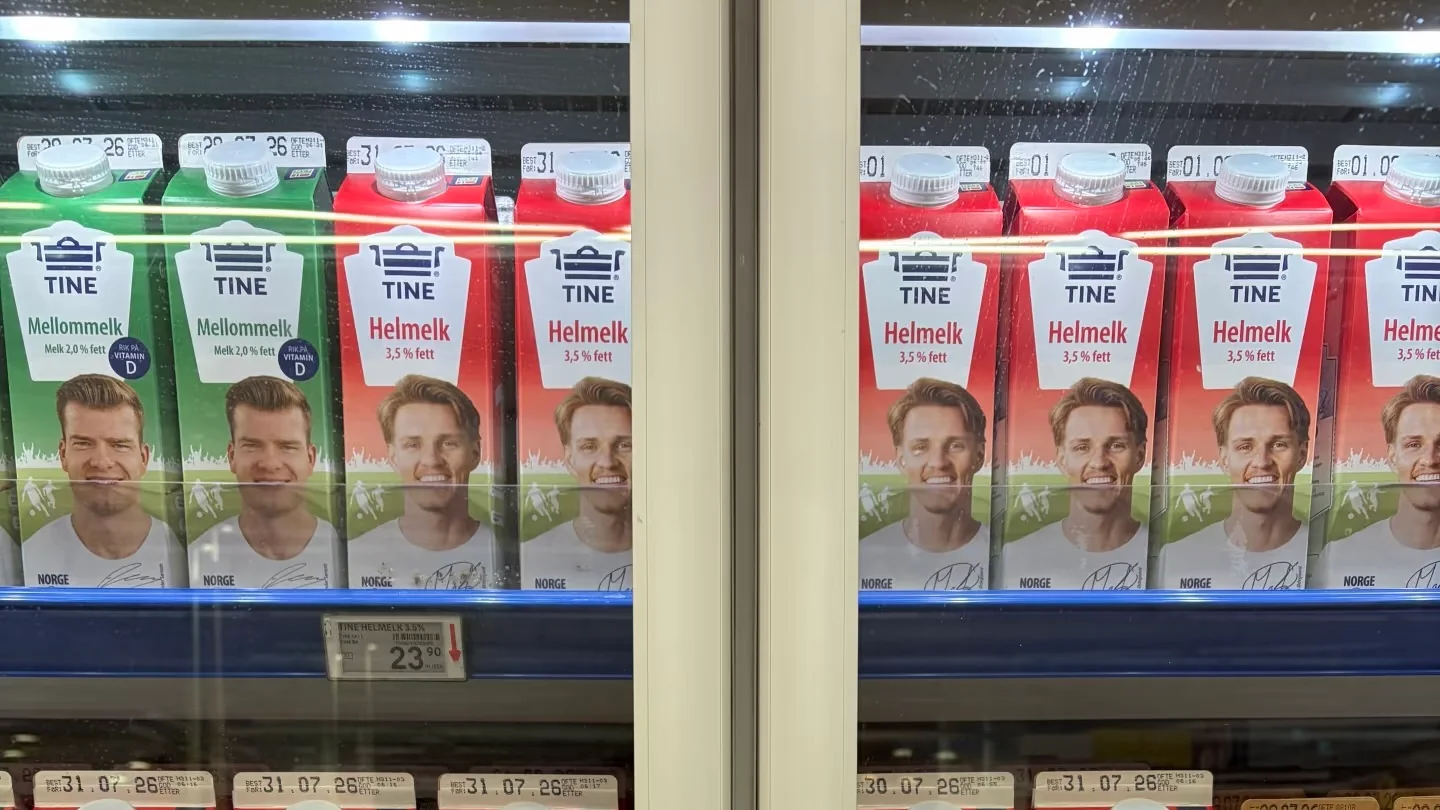
Retail product recognition converts store images or guided shelf video into structured SKU-level data that CPG and retail teams can use to correct availability, pricing, displays, and planogram execution. Instead of asking field representatives to photograph every shelf section separately, Clobotics can turn one continuous video capture into selected, analyzable images and return recognition results to the field workflow.
The objective sounds simple until the system encounters a real store. A shelf scene may contain hundreds of tightly packed products, some hidden, reflected or captured from an angle. Different flavors and pack sizes often share almost identical designs, while old and new packaging may appear at the same time. Recognizing the brand is not enough when the task requires the exact SKU, its price and its shelf position.
A production system therefore does more than answer, “What product is this?” It must validate the evidence, locate individual products, narrow the possible SKU candidates, compare visual and textual signals, reconstruct the shelf and apply the customer’s retail execution rules.
Why retail product recognition is difficult
Traditional image classification usually assigns one label to one image. A retail shelf presents a more complex problem: the system must locate many separate objects, identify each one at the required level and understand how they relate to the physical shelf.
Three conditions make this particularly difficult:
- Field images are inconsistent. Products may be obstructed, reflected, poorly lit or captured from an unusual angle.
- SKU differences can be extremely small. Two packages may share the same brand, colors and layout, with only a flavor, dosage or pack-size line distinguishing them.
- The catalog keeps changing. New products, packaging redesigns and seasonal editions continuously introduce unfamiliar visual evidence.
Research into shelf recognition has identified the gap between product-reference images and real store conditions, the scale of product catalogs and the visual similarity between classes as recurring challenges. For these reasons, Clobotics uses a multi-stage architecture rather than relying on a single unrestricted prediction from a general-purpose vision model. Research on deep-learning product recognition
The workflow at a glance
The complete process can be summarized as:
Capture → Validate → Detect → Retrieve → Verify → Reconstruct → Act
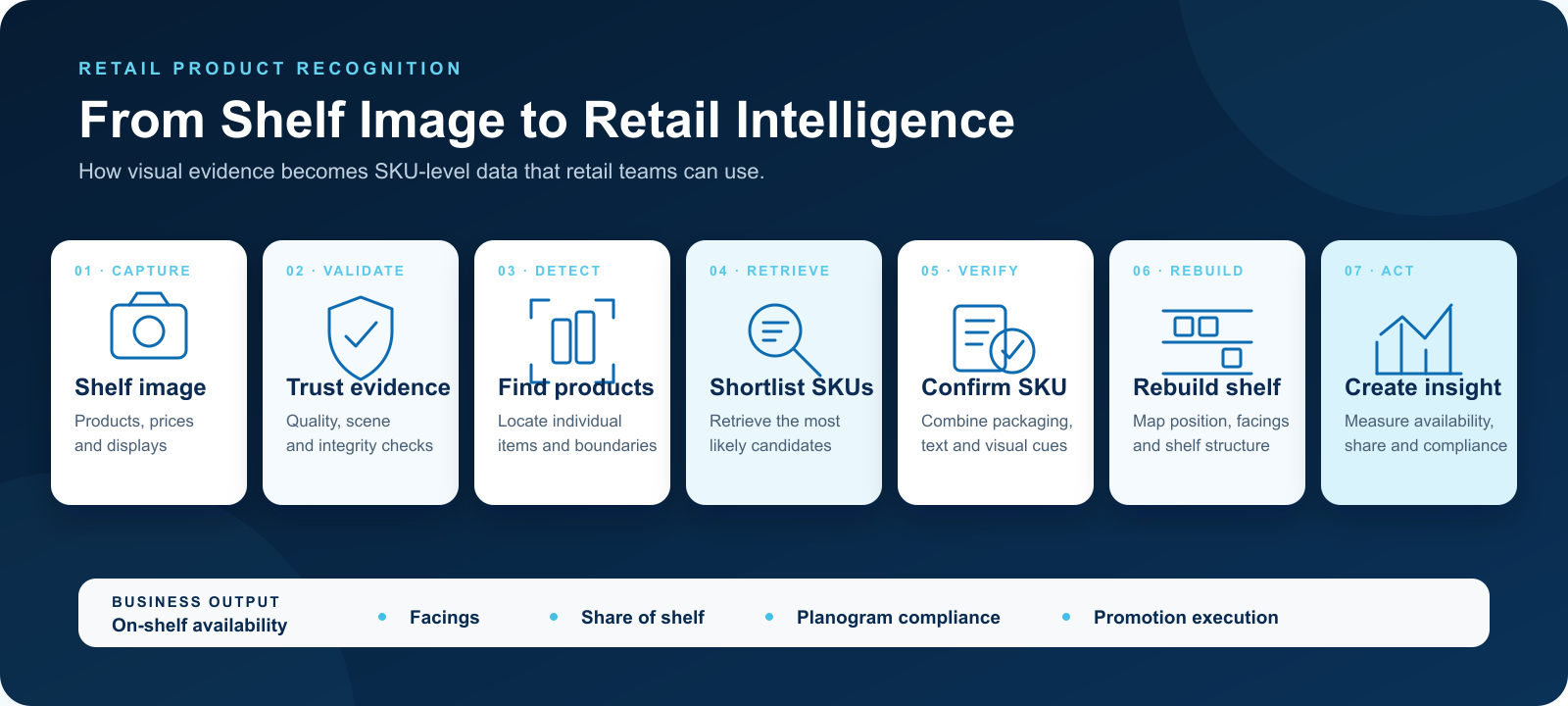
Capture and validation establish whether the evidence can be trusted. Detection locates the relevant objects, retrieval narrows the catalog, and multimodal verification selects the best-supported SKU. The final stages restore the shelf structure and apply the customer’s rules. Because each responsibility remains separate, technical teams can trace an incorrect result to capture, detection, OCR, retrieval, classification, reconstruction or rule processing.
Turn guided shelf video into analyzable images
Recognition begins before an image reaches the product model.
The capture method depends on the physical environment and the required output. A focused photograph may be sufficient for one display or price, while a long aisle or cooler may require guided video. Connected cameras and autonomous shelf-scanning systems can support more frequent observation. A presence check does not require the same coverage and spatial continuity as a share-of-shelf or planogram analysis.
With guided video, a representative scans the shelf in one continuous motion. The device converts the footage into selected two-dimensional images that preserve the useful product and shelf evidence without requiring the complete raw video to become the analysis record. This reduces repeated photography and creates overlapping visual evidence that can be used to locate products and reconstruct the shelf.
The selected images can be checked for coverage and capture quality before submission. With connectivity, they are sent to the cloud for product recognition and rule analysis; when signal is unavailable, capture and image preparation can continue and the evidence can be queued until the connection returns.
Scan once, then analyze the useful shelf frames.
The representative records the shelf naturally while the workflow prepares selected images for SKU recognition and shelf reconstruction.
- Guided capture helps cover the full shelf at a usable pace and distance.
- Video is converted into selected images for more efficient transfer and analysis.
- Cloud recognition returns SKU and execution findings to the field workflow.
Once the evidence has been captured, the platform evaluates whether it is suitable for the assigned task. Depending on the deployment, validation can identify blurred, duplicated or incomplete images and check whether the submission is consistent with the assigned store, time, location and capture sequence.
Recognition accuracy and evidence integrity are not the same measurement. A model could identify every visible product correctly and still produce an unreliable result because the photograph came from the wrong store or omitted half the shelf. Trusted shelf intelligence therefore begins by establishing that the submission is valid evidence of the condition being measured.
Detect, retrieve and verify the exact SKU
Once the evidence passes the required validation checks, the computer vision pipeline identifies the relevant regions in the scene. These may include products, shelf rows, price tags, empty spaces and promotional materials.
Detection establishes where an object is located. Recognition determines what that object is.
For each detected product, the system must search a potentially large catalog. Asking a multimodal model to select freely from thousands of active and historical SKUs would introduce unnecessary uncertainty. Clobotics first narrows the search using product metadata, OCR text, visual features, image and text embeddings, category, market, channel and active assortment. The final model compares the evidence against this controlled set of candidates rather than the entire catalog.

Exact text search and vector retrieval contribute different types of evidence. Text search is effective when packaging or product metadata contains a distinctive brand name, flavor, size or product code. Vector retrieval is more tolerant of incomplete text, OCR errors, packaging variation and differences in word order.
Neither method is sufficient in every case. A visually similar candidate may have the wrong pack size, while a packaging redesign may weaken visual similarity even though the SKU has not changed.
Clobotics combines text and vector retrieval to produce a stronger candidate shortlist. The ranked results can be merged using Reciprocal Rank Fusion, or RRF. A product appearing near the top of both result sets receives more weight than one supported by only a single retrieval method.
RRF does not recognize the product itself. It combines text and vector rankings without comparing their differently scaled raw scores, improving the shortlist sent to the recognition model. Microsoft’s explanation of Reciprocal Rank Fusion
The strongest candidates are passed to a multimodal model together with the product image, OCR text, context and classification rules. Instead of generating an unrestricted description, the model compares the candidates and returns a structured classification of brand, variant, size and pack type.
A simplified result may look like this:
{
  "brand": "Example Brand",
  "variant": "Zero Sugar",
  "size": "500 ml",
  "pack_type": "bottle",
  "candidate_sku": "SKU-10293",
  "review_required": false
}
If the evidence is incomplete or conflicting, the item can be marked for review instead of being forced into an existing SKU.
Reconstruct the shelf and apply retail rules
Retail product data generally follows a hierarchy from department and category through brand, product line and SKU. Clobotics can classify progressively, selecting a higher-level category before retrieving the valid options beneath it. This prevents invalid taxonomy paths and makes errors easier to isolate.
Visual evidence also helps distinguish a bottle, can, carton, pouch, multipack or case. These formats may belong to the same product line while requiring different counting and execution rules.
After identifying the products, the platform reconstructs their spatial relationships. It determines shelf rows, product positions and visible facings while accounting for overlapping photographs or repeated video frames. The output is a structured representation of the shelf rather than a collection of independent product predictions.
The recognition model tells the system what is visible; the business-rule layer determines what it means. The same arrangement may be evaluated differently by market, campaign, customer, package type and store format.
How brand teams turn standards into execution rules
Rule configuration begins with the brand team’s operating standard, not with a generic AI score. Clobotics works with sales, category, trade marketing and field-operations teams to define what correct execution means for each market, channel, store format, campaign and product group.
The team first connects product and campaign master data to observable store conditions. A rule can specify the required assortment, minimum facings, shelf-share threshold, approved price, display type, product arrangement, POSM version, cooler ownership or campaign dates. Conditions can be combined: for example, a priority product family may need to be present, vertically arranged, above a minimum shelf share and supported by the correct promotional material.
Clobotics then translates those standards into configurable checks and tests them against real store evidence. Brand teams review exceptions and edge cases during rollout so the rule reflects actual channel conditions rather than an idealized planogram. Once validated, the rule can be versioned and applied to the relevant stores without changing the underlying recognition model every time a campaign, package or threshold changes.
The result should explain the failure, not merely label the store non-compliant. A field representative might receive “priority SKU missing,” “minimum facings not met,” “incorrect price,” “outdated POSM,” or “display in the wrong location,” together with the evidence and action required before leaving the outlet.
Separate execution failures from flawed field activity
A merchandising failure and an unreliable submission are different problems. The first says the store condition is wrong; the second says the evidence may not be trustworthy enough to judge the store.
Evidence-integrity controls can flag duplicate or reused images, incomplete shelf coverage, poor-quality captures, inconsistent timestamps, location mismatches and content recaptured from another screen. Configurable visit, geolocation and boundary rules help determine whether the evidence belongs to the assigned outlet and task.
These checks regulate the workflow before questionable evidence affects compliance scores, incentives or management reporting. Depending on the program, the system can request a recapture, route the submission for review, exclude it from a KPI or alert a supervisor. Human reviewers handle disputed or unusual cases, and their decisions help refine capture guidance, exception policies and future rules.
This creates a governed operating loop:
Brand standard → Configured rule → Trusted store evidence → Pass or specific failure → Field correction or review → Rule update
Clobotics connects recognized products and shelf geometry to three groups of retail measurements:
- Product presence and on-shelf availability.
- Facings, linear shelf space and share of shelf.
- Price, promotion and planogram compliance.
This is the point at which product recognition becomes shelf intelligence. A missing SKU can generate a replenishment task, a price discrepancy can be routed to a field representative, and a planogram exception can be prioritized by commercial impact. Findings can be delivered through field applications, retail execution platforms, APIs, data files, portals and business intelligence systems.
Explore how Clobotics applies this intelligence to retail execution verification and on-shelf availability.
Keeping a hybrid system reliable
Retail product recognition cannot be treated as a one-time deployment. New products, redesigns and seasonal editions appear continuously, and some products captured in the field may not yet exist in the customer’s master catalog.
Clobotics combines automated recognition with controlled human review. High-confidence, repeatable cases can flow through the system automatically. Unknown products, low-confidence results and conflicting evidence can be routed for validation.
A reviewer’s decision can update the product master, retrieval indexes, recognition rules or future model training. The operating loop is continuous:
Recognition → Exception → Human validation → Master-data update → Model or rule improvement
Human review is not a failure of automation. It prevents uncertain observations from becoming incorrect business data. General-purpose multimodal models make it easier to interpret unfamiliar packaging and combine visual and textual evidence, while production shelf measurement still benefits from specialized detection, fine-grained recognition, OCR, spatial reconstruction, price association and planogram comparison.
The practical architecture is therefore hybrid. Specialized computer vision provides repeatable detection and measurement. Retrieval constrains the decision space. Multimodal AI adds contextual reasoning, while the business-rule layer connects the technical result to the customer’s operating standards.
Retail product recognition is not ultimately about producing more bounding boxes or classification scores. The technical work is only partly complete when an AI system identifies a product. Its value begins when trusted evidence helps a team correct availability, pricing, display or promotional execution while the opportunity is still present.
Frequently asked questions
How is retail product recognition different from image classification?
Image classification normally assigns one label to an entire image. Retail product recognition can locate many products in the same shelf image, identify them at SKU level and reconstruct their shelf positions before calculating retail metrics.
Why not use one general-purpose vision model?
A general-purpose model would need to choose from a large and continuously changing catalog. A staged architecture narrows the candidate set, incorporates product master data and makes the result easier to validate and diagnose.
Can retail AI recognize new products?
AI can help interpret unfamiliar packaging, but a genuinely new product may not exist in the product master. A production system should flag the uncertainty for validation instead of forcing the image into an existing SKU.
How does shelf video become product-recognition data?
A guided video captures the shelf in one continuous pass. Selected frames are converted into analyzable images, checked for coverage and quality, and sent for cloud recognition. The system identifies products, reconstructs shelf context and returns execution feedback to the field workflow.
How are retail execution rules configured?
Clobotics works with brand teams to translate merchandising standards into configurable checks by market, channel, store format, campaign and product group. Rules can evaluate assortment, facings, shelf share, arrangement, price, placement, promotional materials and evidence integrity, then return the exact failed condition and required field action.