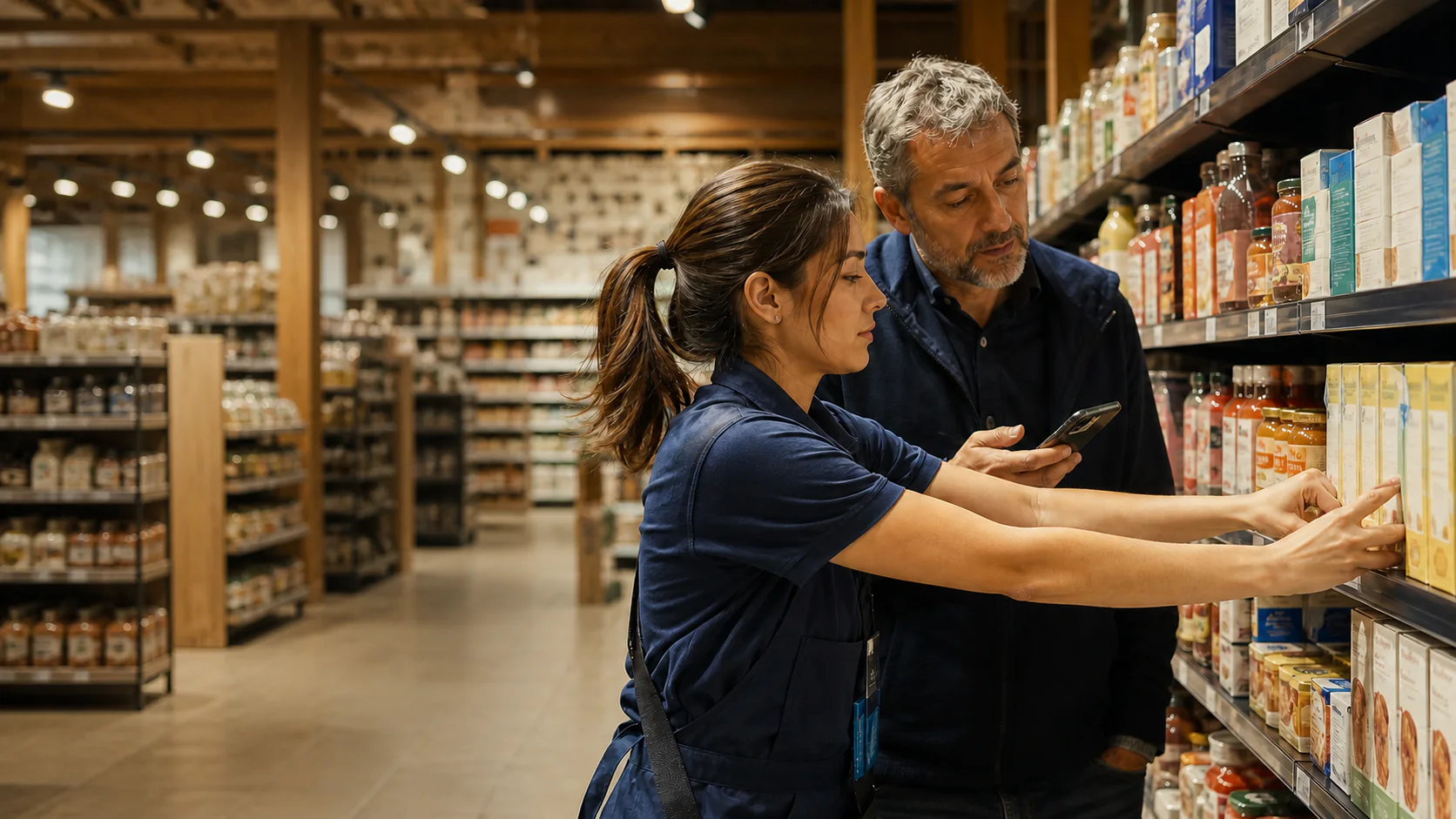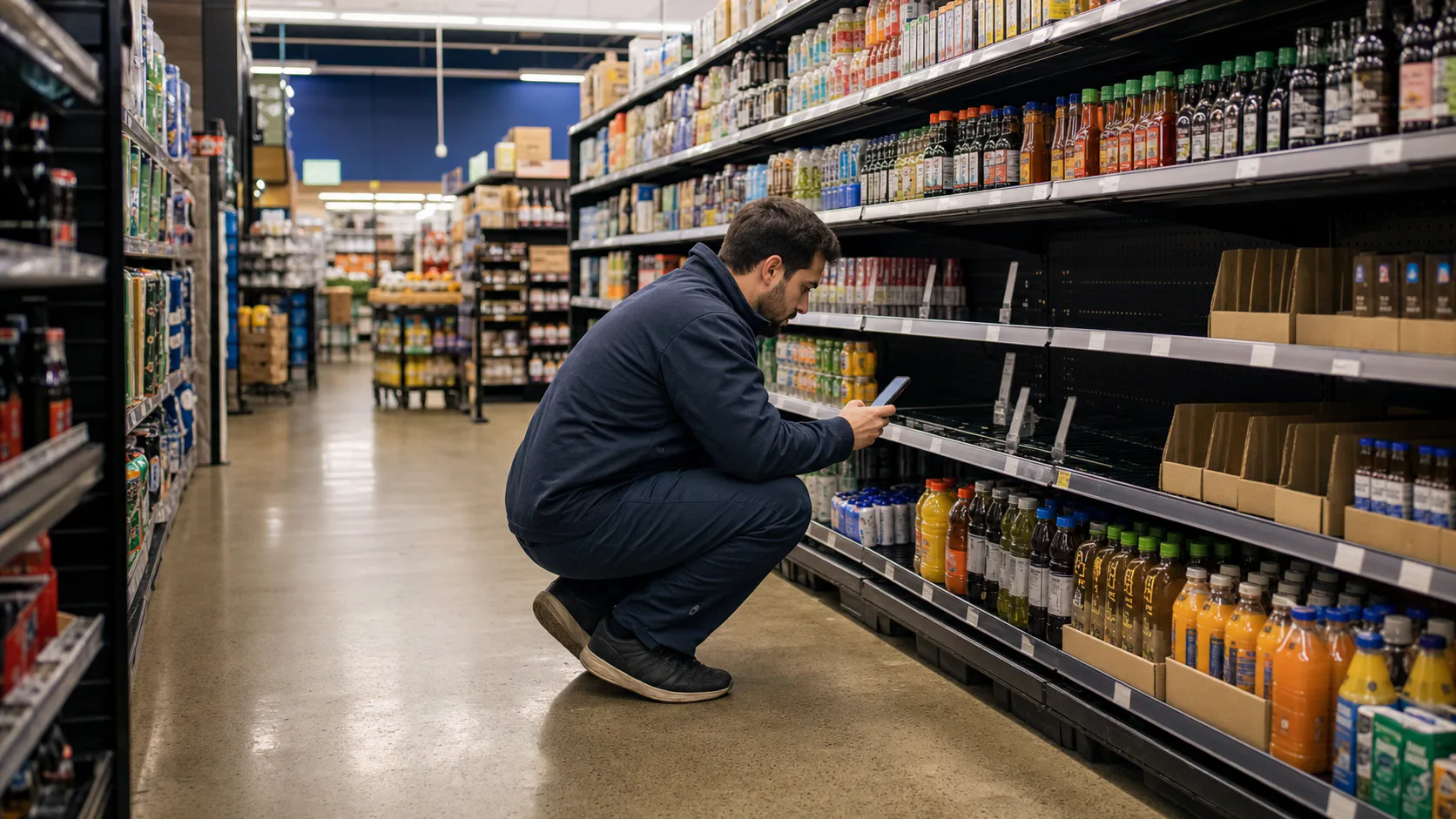
Shelf intelligence is the process of converting observations of physical retail shelves into structured, decision-ready data about product availability, facings, share of shelf, placement, price, promotions, and compliance. It becomes operationally valuable when that shelf data leads to timely store-level action.
For a CPG brand, the shelf is where assortment plans, trade investment, distribution agreements, and field execution become visible to the shopper. A product can be listed in a retailer’s system but absent from the shelf. A promotion can be funded but poorly displayed. A brand can gain distribution while losing facings or share of shelf in important stores.
Shelf intelligence helps teams see those physical conditions consistently. The objective is not simply to collect more store photographs. It is to create trusted shelf data that answers what happened, where it happened, why it matters, and what the field team should do next.
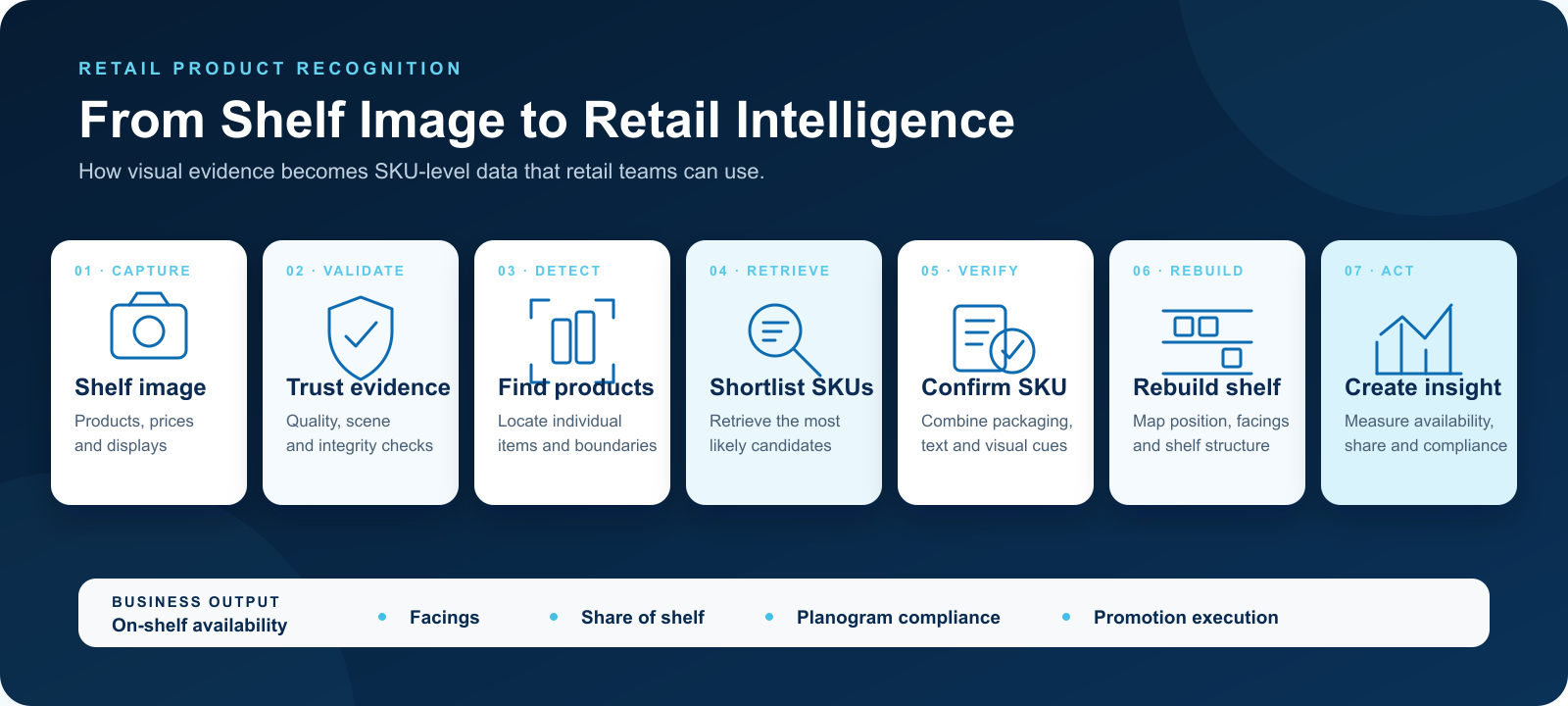
Clobotics category POV: Shelf intelligence is only valuable when shelf data leads to timely store-level action.
What does shelf intelligence measure?
A shelf-intelligence program can measure several related dimensions of in-store execution. The required outputs depend on the commercial question, store format, category, capture method, and available reference data.
On-shelf availability
On-shelf availability, or OSA, measures whether an expected product is physically present and available for a shopper to buy. Shelf images can reveal an empty position, a missing SKU, low stock on display, a distribution gap, or another availability exception that needs validation.
Facings and linear shelf space
A facing is a visible product unit presented toward the shopper. Counting facings and measuring linear space helps category and sales teams understand whether a brand received the space agreed in the plan and whether that allocation changed over time.
Share of shelf
Share of shelf expresses a brand’s presence relative to the total measured shelf or category space. It may be calculated from facings, linear width, or another agreed unit. The definition must stay consistent across stores and reporting periods if the measure is to support meaningful comparison.
Price and promotion
Shelf intelligence can associate products with visible price tags, identify selected promotional materials, and evaluate whether a display follows campaign rules. The workflow may include OCR, spatial association, business rules, and human review when evidence is incomplete.
Planogram and display compliance
Compliance measures whether products, facings, adjacency, placement, displays, and promotional materials follow an agreed standard. Some programs use an exact planogram; others use flexible rules by shelf, bay, row, column, channel, or store type.
Shelf intelligence vs. retail execution vs. store audits
These terms overlap, but they describe different layers of the operating system.
| Concept | Primary role | Typical output |
|---|---|---|
| Shelf intelligence | Converts physical shelf conditions into structured data | SKU presence, facings, share, price, promotion, compliance |
| Retail execution | Manages whether commercial standards are delivered in stores | Priorities, field tasks, visit workflows, correction and verification |
| Store audit | Collects evidence about a store at a point in time | Forms, photos, counts, observations and audit scores |
A store audit can supply the evidence. Shelf intelligence can interpret the evidence. Retail execution determines what the organization does with the result.
This distinction matters when teams evaluate software. A system that recognizes products but cannot validate submissions, maintain master data, apply market-specific rules, or route exceptions may produce interesting analytics without improving execution.
How store images become structured shelf data
The image-to-action workflow normally includes six layers.
1. Define the business question
The team first decides what the program needs to measure: availability, share of shelf, planogram compliance, price, promotions, branded assets, competitor presence, or a combination. This determines the capture and data requirements.
2. Capture valid store evidence
Field representatives may use focused photos or guided video. Connected shelf or cooler cameras can observe selected zones more frequently. Autonomous shelf-scanning systems may cover larger store environments. The best method depends on shelf length, assortment density, visit frequency, and the level of spatial continuity required.
3. Validate the evidence
Before product recognition, the workflow should confirm that the submission belongs to the expected store, visit, aisle, and task. It should also check image quality, coverage, duplication, and integrity. Recognition accuracy cannot compensate for evidence captured from the wrong location or an incomplete shelf.
4. Recognize products and shelf elements
Computer vision can detect product regions, classify SKUs, read selected text, and associate products with shelves, price tags, displays, or promotional materials. Complex shelves may require specialized detection, fine-grained retrieval, OCR, spatial reconstruction, and multimodal analysis rather than one general model.
5. Calculate business KPIs
Recognized products become structured outputs such as product presence, facings, linear space, share of shelf, OSA, price exceptions, promotion compliance, and planogram scores. The rules must reflect the customer’s assortment, channel, market, and execution standard.
6. Route the next action
The system can organize exceptions by store, issue, priority, and business rule. A missing product may trigger a replenishment check. A planogram exception may become a correction task. A price mismatch may be routed to the responsible representative. The field team can then verify what was corrected.
For a deeper technical explanation, see How Retail Product Recognition Works.
Manual audits, crowdsourcing, and AI shelf monitoring
There is no single capture model for every retail program.
| Approach | Strengths | Limitations |
|---|---|---|
| Manual audit | Flexible human judgment; works without model onboarding | Slow counting, variable interpretation, limited frequency, delayed reporting |
| Crowdsourced capture | Broad geographic reach and flexible coverage | Requires strong task controls, evidence validation, and quality management |
| Field-team AI | Returns structured results during existing visits | Depends on capture discipline, device workflow, connectivity, and master data |
| Connected cameras | Frequent observation of selected shelves or coolers | Requires hardware placement, maintenance, privacy planning, and zone selection |
| Autonomous scanning | Repeated coverage across larger store areas | Requires store access, navigation, operational support, and a clear deployment case |
Many enterprise programs use a hybrid model. Human teams handle store context and correction; AI handles repetitive recognition and measurement; connected devices increase observation frequency where the economics support it.
From shelf visibility to field action
Dashboards are useful for trends, but a field-execution program also needs a store-level operating loop:
- Detect an exception from trusted evidence.
- Validate that the exception represents a real execution problem.
- Prioritize it using business rules and commercial impact.
- Route a clear task to the responsible team.
- Correct the shelf condition while action is still possible.
- Capture proof of completion and retain the record.
This is the difference between passive shelf visibility and operational shelf intelligence. The goal is not to admire the data after the selling opportunity has passed. It is to improve the next decision in the store.
Implementation limitations to plan for
Shelf intelligence is powerful, but results depend on the operating design around the model.
- Shelf gaps need interpretation. Empty visual space may indicate a true out-of-stock, low facings, product displacement, blocked visibility, or a flexible layout.
- Master data changes continuously. New SKUs, packaging changes, multipacks, regional variants, and promotional packs require controlled onboarding.
- Store environments are inconsistent. Lighting, glare, occlusion, dense shelves, price formats, and category layouts affect the evidence.
- A KPI needs a stable definition. Teams should agree how facings, linear space, share, OSA, and compliance are calculated before comparing results.
- Human review still matters. Low-confidence or commercially important exceptions may need validation before they become business data.
- Integration determines speed to action. Alerts and KPIs should connect with field applications, retail execution platforms, BI tools, APIs, or enterprise data workflows.
What enterprise buyers should evaluate
When selecting a shelf-intelligence platform, test the complete workflow rather than only a recognition demo:
- Does it capture the shelf evidence required for the use case?
- Can it recognize the products and shelf conditions found in real stores?
- How does it manage new SKUs and local market variation?
- Can it distinguish recognition confidence from evidence integrity?
- Does it support the required KPI and planogram rules?
- Can teams review uncertain findings?
- How quickly do results reach the people who can act?
- Can the platform integrate with existing field and enterprise systems?
- Who owns the source images and structured data?
- Can the workflow scale across stores, categories, countries, and languages?
See the companion guide: How to Choose a Retail Execution Platform.
Clobotics shelf intelligence in practice
Clobotics connects store capture, computer vision, KPI generation, and field workflows through its retail execution platform. Depending on the program, the system can support product availability, facings, share of shelf, planogram compliance, price and promotion checks, branded assets, and competitor conditions.
Public examples show how this model can support enterprise operations:
- A global beverage retail execution program in China connected store evidence with market-specific execution rules.
- A store-wide retail intelligence deployment with Walmart China extended recognition across shelf, pricing, promotion, and competitive signals.
- A Southeast Asia retail execution case study reports improved outlet coverage, faster execution, and measurable commercial impact.
Explore the Clobotics Retail & CPG platform or see how teams use it for retail execution verification.
Frequently asked questions
Is shelf intelligence the same as image recognition?
No. Image recognition identifies visible products and shelf elements. Shelf intelligence adds evidence validation, business rules, KPI calculation, master data, workflow integration, and field action.
What data can shelf intelligence capture?
Depending on the program, it can capture product presence, on-shelf availability, facings, linear space, share of shelf, price tags, promotions, planogram compliance, branded assets, and competitor conditions.
Does shelf intelligence require fixed cameras?
No. Teams can use field photos, guided video, connected cameras, autonomous scanning, or a hybrid approach. The capture method should follow the business question and store environment.
How does shelf intelligence improve retail execution?
It turns physical shelf evidence into structured exceptions and priorities, helping field and headquarters teams identify what needs attention, route a task, and verify correction.
Can shelf intelligence eliminate store visits?
Not in every use case. Connected devices may reduce some observation visits, while field teams remain important for store relationships, contextual judgment, merchandising, replenishment, and corrective action.
What makes shelf data trustworthy?
Trust depends on valid evidence, sufficient shelf coverage, reliable product recognition, current master data, consistent KPI definitions, transparent confidence handling, and review of uncertain findings.