Enterprise buyer’s guide
The right platform must work in the stores your brand finds hardest to manage.
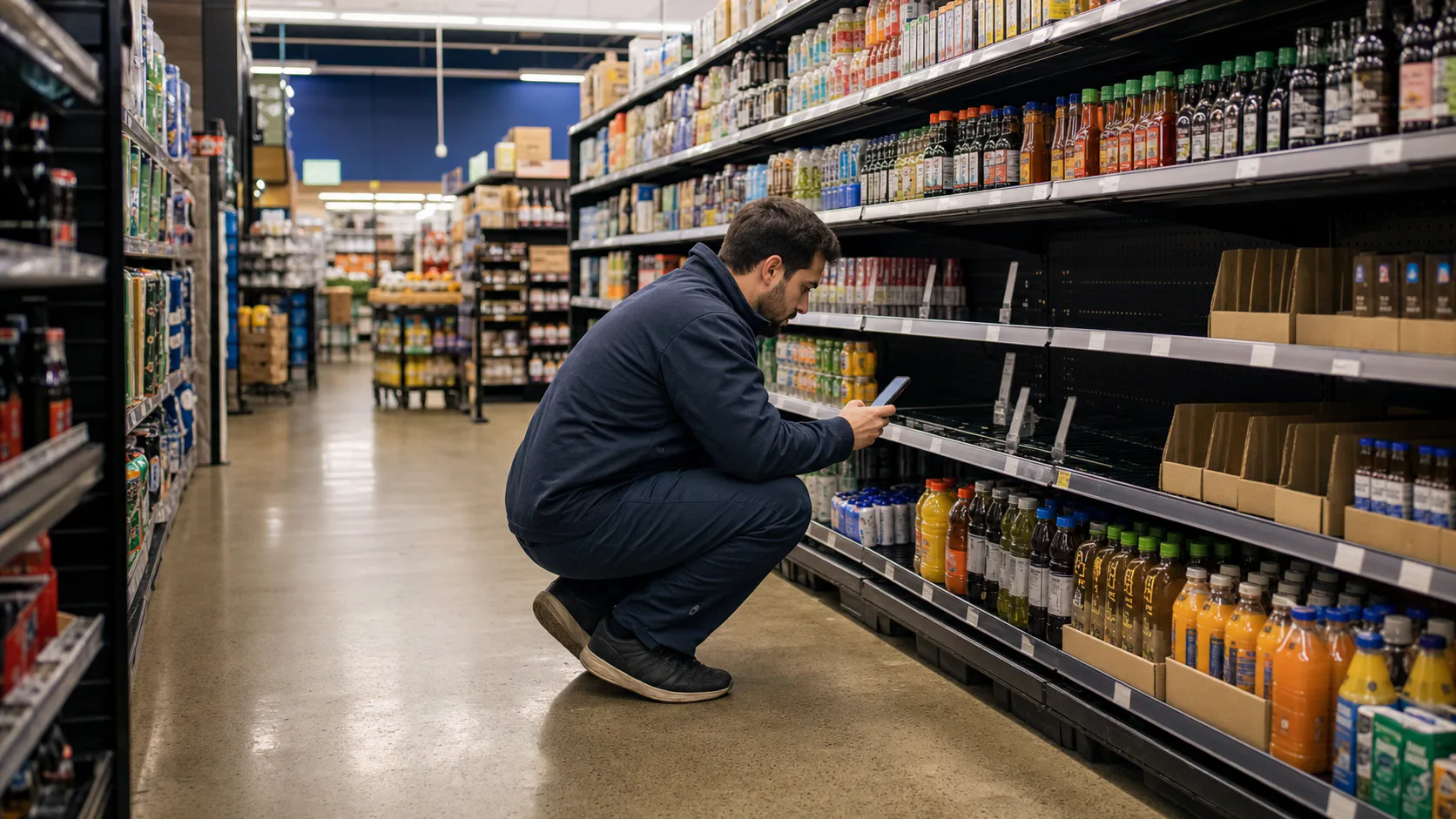
A controlled shelf demo cannot prove performance across thousands of outlets, narrow aisles, dense coolers, changing assortments, and weak connectivity.
Enterprise buyers need one workflow that captures complete evidence, validates each visit, and returns an action before the representative leaves. This guide compares Clobotics, Vision Group Retail, FORM/Trax, and Neurolabs against that requirement.
Companies Included in This Comparison
Clobotics
Founded in 2016 and headquartered in Singapore, Clobotics serves multinational brands, bottlers, distributors, and large retailers across more than 40 countries.
Its platform supports photo and video capture, image stitching, large SKU catalogs, full-store workflows, and visit-integrity controls. See it applied in a large beverage network in China and a video-led US retail program.
Vision Group Retail
Vision Group began its retail technology journey in 2014 with connected cooler tracking and an early European beverage pilot. The US-based company serves large CPG, beverage, beauty, and retail organizations.
Its portfolio combines photo-led shelf recognition with product data, planogram, assortment, and connected-asset tools. Store360 is its main field image-recognition product.
FORM / Trax
FORM began in the United States in 2001 as a frontline data-capture and task-management company. Trax was founded in 2010 in Singapore and became an early enterprise provider of retail shelf recognition.
The businesses combined in 2026. The resulting platform serves enterprise CPG brands, distributors, and retailers seeking field workflows, task management, and image recognition.
Neurolabs
Neurolabs was founded in Edinburgh in 2018 by machine-learning and synthetic-data researchers. It now focuses on CPG manufacturers and retail execution.
Its specialist approach uses synthetic product data and digital twins for rapid SKU modeling and image-led recognition of products, shelves, prices, and promotions.
| Platform | Capture workflow | Difficult-store scope | Time to field action | Evidence integrity |
|---|---|---|---|---|
| Clobotics | Photos, guided video, free-style video, continuous walkthroughs, and connected capture | Long shelves, dense coolers, narrow aisles, displays, and full-store workflows | Same-visit feedback; typical server recognition for an 80-facing image is under five seconds, excluding transfer time | Location, time, duplication, quality, completeness, and visit validation |
| Vision Group Retail | Primarily shelf and display photography within field-rep workflows | Shelf, display, pricing, promotion, and connected asset use cases | Vendor materials claim results within approximately 60–90 seconds | Buyers should confirm visit, duplication, completeness, and exception controls |
| FORM / Trax | Mobile photography plus fixed and automated capture programs | Large-scale shelf execution across retail formats and regions | Depends on workflow, integrations, validation, and deployment configuration | Buyers should confirm capture QA and visit controls across the combined portfolio |
| Neurolabs | Primarily image-led shelf and display recognition | Product, price, promotion, and display recognition; test the broader capture workflow | Validate the full capture-to-action loop during the POC | Validate outlet identity, duplication, completeness, and review controls |
Editorial note: Clobotics publishes this guide based on public competitor information and our enterprise retail experience. Buyers should test every vendor under the same proof-of-concept conditions.
Methodology: Information was reviewed in August 2026. Because vendor definitions vary, claims should be verified rather than treated as directly comparable.
1. Technology Ownership in Retail Image Recognition
Technology ownership determines who controls the roadmap, improves the models, and resolves production problems. Vision Group presents its AI Engine as proprietary, while public partnership materials also describe RetailEye as an important technology foundation and show both companies participating in customer delivery.
Public information does not clearly divide ownership and delivery responsibility. Buyers should ask who owns each production component and which engineering team handles model updates, incidents, data rights, and regional support.
Clobotics develops and operates its retail computer-vision platform directly, giving customers a clearer line from model development and deployment to ongoing production support.
2. How to Compare Recognition Speed, Accuracy, and Market Coverage
Headline numbers are useful only when vendors measure the same thing. Vision Group publicly cites five-second results, a full recognition process of around 90 seconds, and both 55+ and 75-country coverage in different materials.
Is this one image, recognition only, or the completed store task?
What workflow and review steps are included?
Does coverage mean pilots, partners, or active production programs?
These figures use different definitions. Before scoring vendors, define whether speed covers one image or the full task, whether accuracy includes human review, and whether country coverage means pilots or active deployments.
Clobotics separates model creation from production readiness. A model can start from product references in seconds, then be validated against real stores. Catalog capacity scales with the customer’s SKU universe and operating requirements. See the retail product-recognition guide for the full workflow.
Fast onboarding must continue after launch
New products, packaging, and seasonal POSM often launch before enough store images exist for training. Clobotics starts with AI-generated images, then improves the model with live store captures and daily reviewed errors.
In one active program, cold-start recognition begins at about 70%, with an operating target of more than 90% within one week. The brand adds about 20 SKUs and 10 POSM assets each month, keeping the recognition database aligned with market activity.
Neurolabs uses 3D product models and synthetic shelf scenes to reduce its dependence on real shelf photographs. This may accelerate model preparation, but creating a product asset is not the same as proving recognition accuracy in live stores.
Clobotics addresses the same cold-start problem through rapid model initialization, AI-generated pretraining, real store evidence, and continuous error feedback. Buyers should compare time to validated production recognition, not only time to create a SKU model.
3. Evaluating FORM / Trax After the 2026 Merger
In February 2026, Trax’s image-recognition business was acquired and combined with FORM, which operates GoSpotCheck and FORM OpX.
Recognition technology, delivery teams, and customer programs
Acquired by a Gemspring affiliate
Added to GoSpotCheck, FORM OpX, and an existing product portfolio
FORM gains an established recognition library, but buyers still need to assess integration maturity. Confirm whether the products run on one architecture, who owns implementation, and how much vendor support is required after launch.
These service requirements affect time to value and operating cost. A POC should measure recognition output, client workload, field effort, configuration, and ongoing support hours.
Measure speed across the full workflow, not only the recognition model. A three-minute result may support reporting but arrive too late for an in-store correction. Test with real devices, bandwidth, review rules, and integrations.
Clobotics returns feedback while the visit is active. Guided video becomes stitched image evidence, moves to the cloud for analysis, and returns corrective actions to the field app.
Without a signal, capture continues and evidence is queued for upload. A global consumer-goods deployment reduced collection time by 33% and improved recognition pass rates.
Observed end-to-end image-processing time; validate under the buyer’s production conditions.
Video to frames, cloud analysis, and actionable feedback while the representative remains in store.
Video and image evidence are prepared locally, queued, and uploaded when the connection returns.
Clobotics operates across established and emerging retail markets through the same core platform, reducing the need to divide global execution between regional technology stacks.
4. Photo vs. Guided Video for Retail Shelf Capture
Photo-based recognition works well for a defined display or short shelf. Problems emerge when representatives must photograph a long aisle, crowded cooler, or entire store. Missing overlap creates gaps; excessive overlap can duplicate products. Narrow aisles, shoppers, and different phone cameras add variation.
Neurolabs approaches recognition differently. Its proprietary ZIA engine uses synthetic data and digital product twins to train product models without depending entirely on historical shelf photographs.
Its current workflow is primarily image-led. ZIA can recognize selected frames from smart-glasses video, but buyers should distinguish frame recognition from a guided video workflow that manages store coverage end to end.
Multiple photos
- Position
- Overlap
- Retake
- Stitch
- Check completeness
Guided video
- Choose the task
- Record the store
- Upload to the cloud
- Auto-stitch and analyze
- Return actions to the app
Clobotics lets brands choose the capture method around the environment: a photo for a focused display, guided video for long shelves and dense coolers, a continuous walkthrough for multiple zones, or connected cameras and autonomous scanning when greater frequency is needed.
Capture quality affects field adoption and every KPI that follows. The pharmaceutical retail execution case shows the workflow handling similar SKUs, price, POSM, placement, and exception review.
From product recognition to a spatial store map
Clobotics can turn full-store capture into a spatial map of boundaries, aisles, shelves, endcaps, fixtures, category locations, and walkable areas. Each task and recognition result can be linked to the correct part of the store.
This store-level model supports coverage planning, route guidance, asset location, and full-store execution. It differs from a SKU-level 3D product model: one organizes the physical store; the other helps train product recognition.
 Aisle 4Aisle 8BeveragesDairyFrozenCheckoutPharmacyDisplay
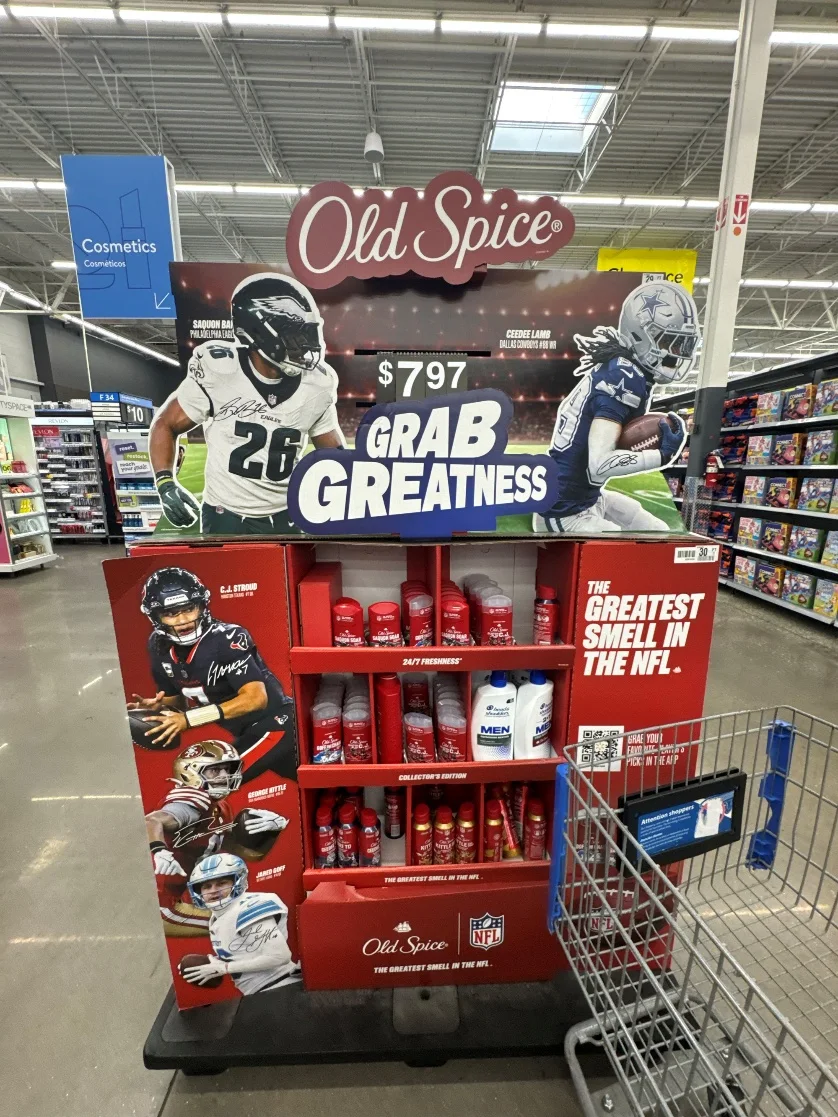 Display zone · evidence captured
5. Why Visit Integrity Matters in Retail Execution Software
A model can identify every visible product correctly and still produce the wrong business conclusion. If an image is old, duplicated, taken from the wrong outlet, or captures only part of the required display, the compliance score is compromised before recognition begins.
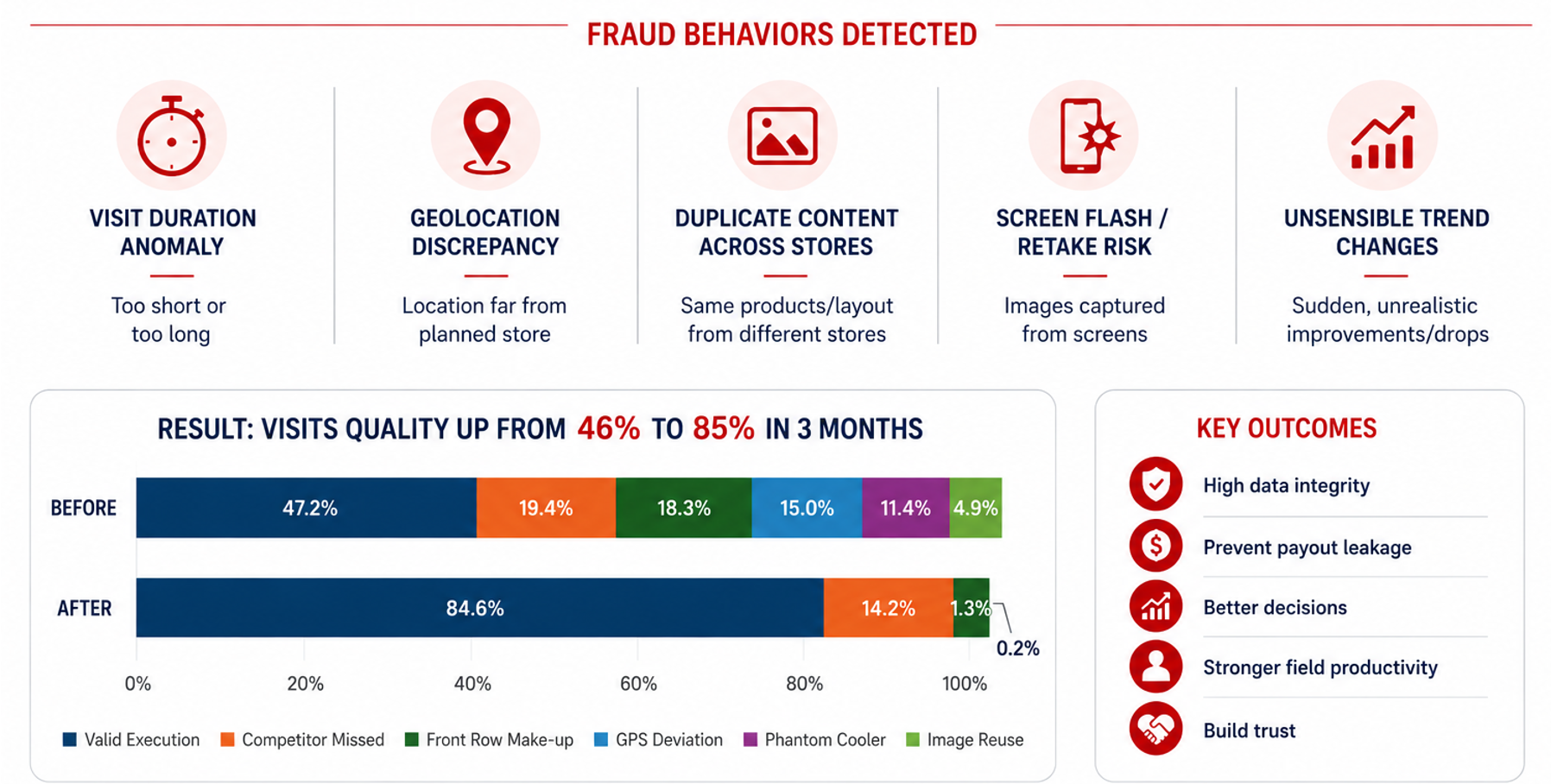
Clobotics validates the evidence as well as the products. Controls can evaluate location, time, duplication, image quality, capture completeness, and visit integrity before results enter reporting.
A shelf-recognition tool reports what appears in an image. A retail execution platform must also verify the store, visit, and task. In a large beverage program in China, video cut collection time by 40% and suspected ghost visits fell from 32% to 1%.
How to Shortlist Retail Image Recognition Vendors
Vision Group Retail
Consider for photo-based shelf execution and access to a large product library.Clarify technology ownership, customer-data use, and deployed capabilities.FORM / Trax
Consider for established recognition and field-task management.Examine the post-merger roadmap, integration maturity, migration responsibility, and vendor-led service requirements.Neurolabs
Consider for synthetic-data-led SKU model creation.Test the complete field-capture workflow, production accuracy, and time from image to corrective action.Clobotics
Consider when the requirement extends beyond isolated shelf recognition.Large configurable catalogs, guided video, full-store mapping, global deployment, and evidence-level validation.How to Test Retail Image Recognition Vendors in a Proof of Concept
Do not test only on a clean demonstration shelf. Use the stores that create the most operational difficulty. The enterprise evaluation guide adds criteria for integration, governance, implementation, and operating cost.
- Who owns and supports the production recognition models?Ask for named responsibility across IP, roadmap, incidents, and model operations.
- Can one workflow cover a shelf, cooler, display, and full store?Use your real store formats, not a vendor-controlled demo shelf.
- How does the system perform in narrow, crowded, or poorly lit outlets?Include device, connectivity, shopper traffic, and aisle constraints.
- Can it detect duplicate, incomplete, or location-mismatched evidence?Measure visit trust as well as product recognition.
- How long does a new SKU take to reach validated production recognition?Separate rapid model initialization from production readiness.
- Can the same platform support every required region and channel?Confirm platform, contract, model, and support continuity across the planned deployment.
- What happens to customer data during training and after the contract ends?Document ownership, retention, portability, and deletion.
- Will results reach the field team while they can still correct the problem?Test the complete loop from capture to action and verification.
The same questions should be asked of every shortlisted provider, including Clobotics.
Frequently Asked Questions About Retail Image Recognition Vendors
What should buyers compare in a retail image recognition platform?
Compare capture workflow, difficult-store performance, SKU onboarding, evidence integrity, time to action, integrations, regional delivery, and operating effort.
What is the difference between photo and guided-video retail capture?
Use photos for focused displays and short shelves. Use guided video for long shelves, dense coolers, and multi-zone capture. Test both in real stores.
Which retail image recognition platform is best for multinational deployment?
Prioritize one operating model across regions and channels. It should handle large catalogs, difficult stores, visit validation, and same-visit action. See the Clobotics FAQ for speed, offline use, scale, integrations, and data ownership.
Make the shortlist
Choose a platform that works in your hardest stores.
Test capture, speed, data integrity, and field action under real operating conditions.